Don't Hit Apply Until You've Done These 12 Things
Don’t hit apply in 2026 without doing these 12 resume checks. Learn how to optimize for ATS systems, AI screening, one-way video interviews, salary research, and keyword alignment before submitting your application.


Submitting a resume used to mean sending a document to a person. In 2026, that assumption is wrong.
For most mid-size and large companies, your resume is read by software before a recruiter ever sees your name. Platforms like Greenhouse, Workday, Lever, and Ashby now layer AI scoring systems on top of traditional applicant tracking systems. These tools do not “read” your resume the way a human does. They parse it into structured data, compare it against job requirements, score alignment, and rank candidates before a recruiter clicks anything.
That means the question is no longer, “Does this look good?”
The real question is, “Does this convert into clean, high-signal data?”
If you want to compete in that environment, here are 12 things you should do before you touch the apply button.
1. Test how your resume parses.
Upload it into an ATS scanner or paste it into a plain text editor. Does your job title separate cleanly from your company name? Do dates stay attached to roles? If your formatting collapses into chaos, the system is misreading you. A recruiter might never see the version you designed.
2. Strip out fancy formatting.
Text boxes, multi-column layouts, icons, and graphics look modern but often break parsing logic. Clean hierarchy beats clever design. Standard headings such as Experience, Education, and Skills are safer than creative section titles.
3. Align language with the job description.
Do not stuff keywords. Do a mirror intent. If the role requires stakeholder management, and your resume says “worked with multiple teams,” tighten it. Ambiguity generally weakens matching while being precise strengthens scoring.
4. Make every bullet prove something.
Responsibilities are weak signals. Outcomes are strong signals. Replace “responsible for marketing campaigns” with something measurable. Numbers anchor performance and help AI systems classify impact.
5. Remove conflicting identity signals.
If you are applying for a data analyst role, but your resume leans heavily into graphic design and event planning, you dilute your profile. AI clustering models build a picture of who you are professionally. Make sure that picture is clear.
6. Cut generic AI-sounding language.
Recruiters are fatigued. They can spot “results-driven professional” in seconds. Replace empty phrases with specifics. Shorter, sharper sentences outperform inflated corporate tone. Use our resume action verbs and synonyms tool to eliminate weak phrasing.
7. Check experience level alignment.
If a job requires five years of experience and your resume shows three, you need to strengthen depth within those three years. Expand your achievements and clarify scope. Show ownership. Do not assume the system will “infer” seniority.
8. Confirm your most important skills appear in context.
Listing Scala in a skill section is weaker than describing how you built a forecasting model in Scala that improved reporting accuracy by 21 percent. Context increases weight.
9. Sync your resume with LinkedIn.
Recruiters compare. AI tools sometimes cross-reference public data. Mismatched dates, different job titles, or inconsistent descriptions create silent doubt. Make sure your LinkedIn headline also reflects the role you are targeting, because some screening systems ingest or scrape profile data, and inconsistent positioning can weaken how your candidacy is classified.
10. Ditch the Buzzwords at the Top
Your summary should not be a motivational speech. It should position you clearly in two to three lines. If it reads like branding copy, rewrite it.
From passive
to powerful
Your resume gets scanned fast in 2026. If your bullets start with “helped” and “responsible for,” you lose signal. Use our free action verbs tool to upgrade wording, tighten intent, and sound like you owned the work.
11. Remove irrelevant early-career noise.
You do not need to prove you worked every job you ever had. Focus on relevance. Signal density matters more than length.
12. Reverse-score yourself.
Pretend you are the algorithm. Compare your resume against the job description line by line. Where would you deduct points? Missing software? Vague scope? Unclear ownership? Fix those gaps before submission.
The Rise of One-Way Video and Async Screening
Even if your resume clears the AI filter, the next stage may not be a live conversation.
In 2026, more companies are using one-way video interviews and asynchronous screening tools as a first human-touch layer. Candidates record answers to pre-set questions on platforms such as HireVue or Spark Hire. Recruiters review responses later, sometimes alongside AI-generated summaries and competency scoring.
This stage is not casual. It is very structured and your resume heavily influences what happens here. First, your resume often determines which questions you are asked. Many systems dynamically generate prompts based on your background. If your resume emphasizes leadership, you will likely get a leadership scenario. If it leans technical, expect technical depth. The framing you create on paper shapes the evaluation lens you walk into.
Second, recruiters watch these videos with your resume open beside them. If you claim ownership of a large initiative, they expect clarity when you explain it. If you list impressive outcomes, they expect you to articulate the story behind them. Any exaggeration becomes obvious fast.
Third, AI-assisted screening tools increasingly analyze structure, not just content. They may score communication clarity, conciseness, and alignment with competencies outlined in the job description. If your resume positions you as analytical but your answers are vague, that mismatch stands out.
Your resume is not just a document that gets you to the next stage but it also sets expectations for how you will perform in it. Before you apply, ask yourself: if I had to speak confidently for two minutes about every bullet point on this page, could I?
If the answer is no, revise the resume before you revise your answers.
Best Free Tools to Check Your Resume Before Applying
You should not be manually guessing whether your resume is strong enough in 2026. There are free tools that simulate how systems and recruiters will interpret it. Use them.
For readability, paste your resume into Hemingway Editor. If your sentences are long, bloated, or filled with passive voice, it will show you immediately. Clear writing is not just aesthetic. AI scoring systems often reward concise, direct phrasing because it maps more cleanly to competencies.
For grammar and clarity checks, Grammarly can catch small errors that undermine credibility. Even minor inconsistencies create friction when a recruiter is reviewing dozens of profiles in a sitting.
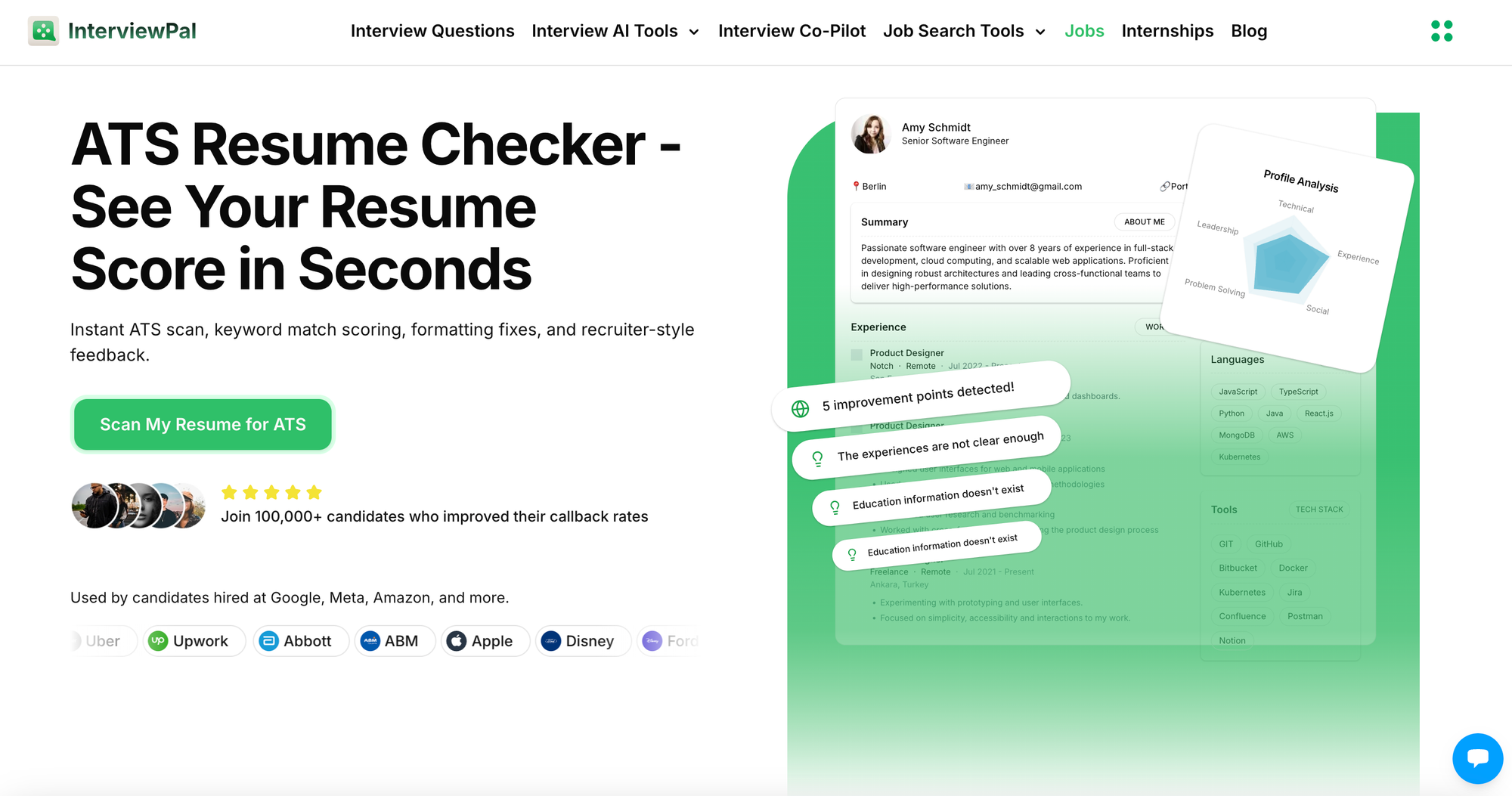
For ATS parsing and keyword alignment, use tools that actually simulate applicant tracking logic. This is where purpose-built resume scanners matter. Platforms like InterviewPal allow you to upload your resume and compare it directly against a job description. Instead of guessing whether you match, you see where alignment is strong and where it is thin. That feedback loop is more valuable than subjective opinions.
You can also test formatting by uploading your resume into a free ATS demo environment or simply copying it into a plain text file. If the structure collapses, that is your warning sign.
The goal is not to over-optimize or “game” the system. It is simply to remove blind spots. In 2026, small structural issues or alignment gaps can quietly lower your ranking without you ever knowing why.
The Checklist Also Changes Depending on Who You Are
Not every applicant should be optimizing for the same things. A career changer, someone aiming for a promotion, and an entry-level candidate are being evaluated through completely different lenses. Your checklist needs to reflect that.
If you are a career changer, your resume must solve one problem above all else: credibility. AI systems and recruiters will immediately look for signals that you can perform in the new domain. That means your checklist should focus heavily on transferable skills framed in the language of the target role. Rename vague job titles if necessary for clarity, without being misleading. Pull forward relevant projects. Cut unrelated experience aggressively. Add proof of skill transition such as certifications, measurable outcomes, or real-world work that bridges the gap. The biggest mistake career changers make is assuming recruiters will “connect the dots.” They will not. Your resume has to draw the line clearly.
If you are applying for a promotion or a more senior role, your checklist shifts from skill demonstration to scope and ownership. AI systems and recruiters look for scale. Did you lead initiatives or just contribute to them? Did you manage budgets, people, cross-functional teams? Did you influence strategy? For promotions, your resume must show progression. Expanded responsibility. Larger impact. Bigger decisions. If your bullets look similar across roles over time, that signals stagnation. Senior candidates are filtered based on leadership language and strategic outcomes, not task execution.
If you are entry-level, the lens changes again. Recruiters are not expecting deep experience, but they are looking for indicators of initiative and learning velocity. Your checklist should prioritize clarity, technical skills in context, internships, projects, coursework relevance, and quantified achievements wherever possible. Entry-level resumes often fail because they read like class schedules instead of evidence of applied ability. Even part-time jobs can demonstrate accountability, teamwork, and reliability if framed properly.
The mistake candidates make is copying advice that was written for someone at a completely different stage. A mid-career promotion strategy can hurt a recent graduate. A career-change narrative can weaken someone applying internally for growth.
Before you hit apply, make sure you are optimizing for the version of you that the job requires. Not the version you used last year.
Know the range
before you apply
Salary isn’t a surprise at the end anymore. In 2026, recruiters ask early, and AI screening moves fast. Do a two-minute range check so you don’t waste applications on lowball roles and you don’t anchor yourself too low when the conversation starts.